
Why would a 70% concentration of rubbing alcohol be more lethal to bacteria than a 100% pure solution? It's a question that highlights the gap between common intuition and clinical reality in the modern Australian studio. You likely recognise that your client's safety is the foundation of your reputation, yet the conflicting advice surrounding Isopropyl and Ethanol concentrations can make even a seasoned artist second-guess their setup. We understand the pressure to balance rigorous hygiene with the need to avoid the dreaded alcohol burn that can compromise a fresh piece.
This guide empowers you to master the science of Isopropyl Alcohol to ensure maximum skin integrity and studio safety in your professional practice. You'll gain a clear understanding of why 70% solutions are the gold standard for microbial cell wall penetration and how to align your workflow with the 2014 Australian infection control guidelines. We're breaking down the chemistry of sterilisation, comparing specific concentrations, and providing a definitive protocol for an infection-free environment that respects the skin's natural healing journey.
Key Takeaways
- Understand the molecular distinction between Isopropyl Alcohol and Ethanol to elevate your clinical standards and ensure optimal sterilisation.
- Discover why the 70% concentration of rubbing alcohol outperforms pure solutions by utilising water as a catalyst for deep microbial penetration.
- Master the professional "clean-to-dirty" flow to maintain a sterile environment and prevent cross-contamination throughout the tattooing process.
- Ensure your practice meets Australian Health Department guidelines and regulatory standards for skin penetration industries to protect both artist and client.
- Prioritise skin health by integrating medical-grade chemicals into your workflow, preserving the canvas while upholding a sophisticated, clinical aesthetic.
What is Rubbing Alcohol? The Science of Isopropyl Alcohol (IPA)
Understanding the fluids that touch your skin during a tattoo or laser session is the first step toward professional skin health. Rubbing alcohol is a denatured alcohol solution, most commonly consisting of Isopropyl Alcohol (IPA). While it’s a staple in every Australian household medicine cabinet, its role in a clinical setting is much more precise. To understand What is Rubbing Alcohol? one must look at its chemical utility as a solvent and disinfectant. In the Lab, we view it as a critical tool for ensuring the canvas is sterile and free of surface lipids that could interfere with technical precision.
The chemical distinction between Isopropyl Alcohol and Ethanol is subtle but significant for skin outcomes. IPA is a secondary alcohol with the formula C3H8O, used primarily for its rapid antimicrobial properties. Its structure allows it to dissolve a variety of non-polar compounds, making it more effective than ethanol at stripping away natural oils. This is why it’s the go-to for skin preparation. From a historical perspective, the use of alcohol as an antiseptic gained momentum after Joseph Lister’s 1867 breakthrough in sterile surgery. By the 1990s, the Australian tattoo industry adopted these clinical standards to move away from the "street shop" era into the sophisticated, boutique environments we see today.
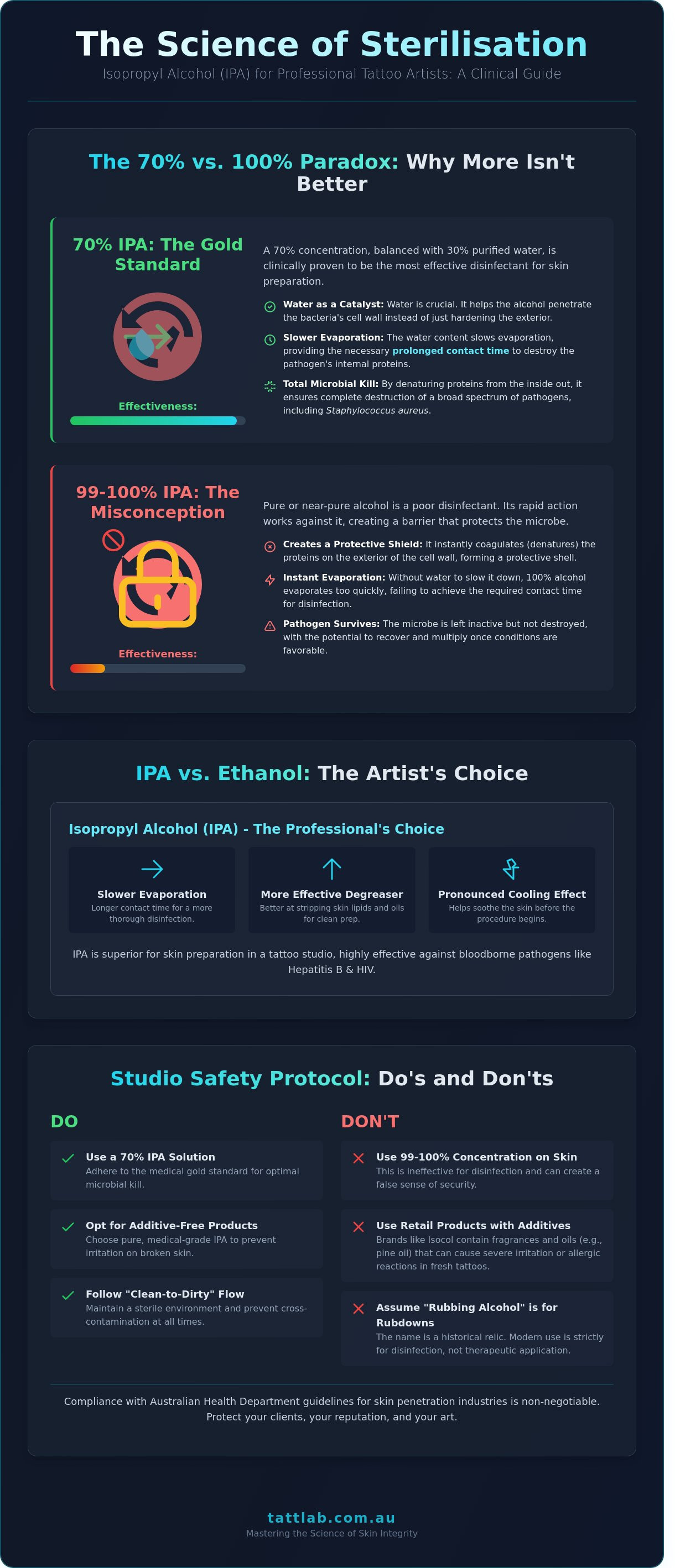
When we look at rubbing alcohol through a laboratory lens, the only metrics that truly matter are purity and concentration. It’s a common misconception that 100% purity is better. In reality, a 70% concentration is the medical gold standard. The 30% water content acts as a necessary catalyst. It slows down evaporation and allows the alcohol to permeate the cell walls of bacteria. If you use 99% alcohol, it often coagulates the proteins on the outside of a cell wall instantly, creating a protective shield that lets the pathogen survive underneath. Precision in concentration ensures total clearance of microbes.
Isopropyl vs. Ethyl Alcohol: Which is Better for Artists?
For practitioners in Melbourne and across Australia, IPA is generally superior to Ethyl Alcohol (ethanol) for skin preparation. IPA has a slightly slower evaporation rate, which provides a longer contact time with the skin and a more pronounced cooling effect. This helps soothe the area before the first needle pass or laser pulse. It’s highly effective against bloodborne pathogens, including Hepatitis B and HIV, which is non-negotiable in our industry. Most professional studios source bulk IPA for approximately A$20 per litre, ensuring they have a constant supply of high-grade sanitiser that meets Australian health regulations.
The "Rubbing" in Rubbing Alcohol: Why the naming persists
The term "rubbing" is a linguistic relic from the early 20th century. Originally, these solutions were used for therapeutic "rubdowns" to ease muscle aches or break a fever through evaporative cooling. While the name persists, modern rubbing alcohol is a far cry from those early home remedies. We must warn against using retail products like Isocol for professional tattoo care. While Isocol contains 70% IPA, it also includes additives like pine oil and fragrances. These ingredients are fine for intact skin, but they can cause significant irritation or allergic contact dermatitis when they enter an open wound or a fresh tattoo site. Always opt for clear, additive-free solutions to protect the integrity of your skin journey.
The 70% vs. 100% Paradox: Why More Isn’t Always Better
Logic suggests that a higher concentration of an active ingredient should yield a more powerful result. In the clinical reality of skin preparation, this assumption is fundamentally flawed. The efficacy of rubbing alcohol depends entirely on its relationship with water. While 100% isopropyl alcohol exists, it's rarely the optimal choice for a sterile tattoo environment. Water acts as a vital catalyst in the disinfection process. It facilitates the movement of alcohol molecules into the cell walls of bacteria and viruses. Without this aqueous component, the alcohol cannot penetrate the pathogen effectively.
The presence of water also regulates the evaporation rate. Pure 100% alcohol evaporates almost instantly upon contact with air. This rapid transition from liquid to gas prevents the solution from achieving the required contact time for total microbial clearance. In Australia, health guidelines for skin penetration procedures emphasize the need for sustained contact to ensure safety. A 70% solution provides the necessary window for the chemical to work before it disappears into the atmosphere. It's a precise balance that maintains the safety of the procedure without compromising the efficiency of the artist's workflow.
The Biology of the Kill: How Alcohol Destroys Pathogens
Disinfection isn't just a surface rinse; it's a calculated biological attack. When 70% alcohol is applied to the skin, it targets the lipid membrane of the germ. The water content in the solution prevents the alcohol from evaporating too quickly, allowing it to seep through the cell wall. Once inside, the alcohol denatures the internal proteins. It essentially unfolds the protein chains that the bacteria need to survive and replicate. This process is highly effective against a broad spectrum of pathogens, including Staphylococcus aureus and various blood-borne viruses.
Using 100% concentration actually hinders this process through a phenomenon known as instant coagulation. When pure alcohol hits a bacterium, it causes the proteins on the exterior of the cell wall to clump together immediately. This creates a literal wall of hardened protein that protects the interior of the germ. The pathogen remains alive but dormant behind this protective shield. Once the 100% alcohol evaporates, the germ can potentially become active again. This is why 70% remains the gold standard for creating a truly sterile field in a professional lab setting. It ensures the kill is deep and permanent rather than just superficial.
Skin Integrity and Alcohol Concentration
The tattooing process is an intentional trauma to the skin, making the health of the stratum corneum a primary concern. High concentrations of alcohol are notoriously aggressive. They strip away the natural lipids and moisture barriers that protect the epidermis. When an artist uses a concentration nearing 100%, they often trigger "skin shock." This results in extreme dehydration, redness, and a compromised texture that can make ink saturation more difficult. The skin becomes brittle rather than supple, which can lead to excessive trauma during the tattooing process.
Maintaining a healthy skin barrier is a core component of the Tatt Lab philosophy. We view the skin not just as a canvas, but as a living organ that requires meticulous skin health management to ensure the best aesthetic outcomes. A 70% solution is significantly gentler on the tissue. It provides the necessary antimicrobial protection while leaving enough moisture to prevent the skin from cracking or overreacting to the needle. This approach supports a smoother healing journey and helps the lymphatic system process the procedure more efficiently. While 100% alcohol is appropriate for sterilizing non-porous stainless steel workbenches, it has no place on a client's skin. Balancing sterility with tissue respect is what separates a clinical specialist from a standard operator.
Professional Protocols: Rubbing Alcohol in the Tattoo Studio
Precision in a tattoo studio mirrors the rigor of a clinical laboratory. Every movement follows a unidirectional "clean-to-dirty" flow to prevent cross-contamination. This protocol ensures that sterile equipment never encounters a contaminated surface. Within this workflow, rubbing alcohol plays a specific, restricted role. It's a high-level antiseptic for skin but only a low-level disinfectant for environmental surfaces. In Australia, the 2012 Guidelines for Personal Skin Care Services dictate that practitioners must distinguish between these two applications to maintain a safe environment. Relying on the wrong chemical for the wrong task compromises the integrity of the procedure and the client's health.
Pre-Tattoo Skin Preparation
Preparing the canvas is a three-stage process designed to protect the skin's barrier while ensuring the art lasts. First, the artist performs a controlled shave using a single-use safety razor to remove hair that could harbor bacteria. Second, the area is cleansed with a pH-neutral medicinal soap. Finally, a wipe with 70% isopropyl alcohol removes 90% of surface lipids and transient microbes. This degreasing step is vital. Without it, the stencil won't bond to the epidermis, leading to blurred lines or premature fading during the session. To minimize discomfort, artists should allow the alcohol to evaporate completely for 30 seconds before applying the transfer medium. This prevents the "sting" often associated with the initial needle penetration.
Workstation and Equipment Disinfection
While rubbing alcohol is effective for quick wipes of non-porous stainless steel trays, it has significant limitations. It's ineffective against highly resilient bacterial spores or non-enveloped viruses. For comprehensive safety, Australian studios use TGA-listed hospital-grade disinfectants like Viraclean or wipes containing quaternary ammonium compounds. These chemicals provide a broader spectrum of kill-rates than alcohol alone. You must also consider your equipment's longevity. Constant exposure to high-percentage alcohol can cause micro-fractures in acrylic barriers and degrade the anodised finish on high-end rotary machines. Protecting your investment requires using the specific cleaners recommended by manufacturers, rather than a one-size-fits-all alcohol approach.
A dangerous misconception persists that soaking needles in alcohol can replace the need for an autoclave. This is false. Alcohol is a disinfectant, not a sterilant. It cannot achieve the total destruction of all microbial life, including spores. In Australia, any reusable equipment that penetrates the skin must be processed in a Class B autoclave at 134°C for at least 3 minutes, following AS/NZS 4815 standards. Most modern studios have shifted to 100% single-use, pre-sterilised cartridges to eliminate this risk entirely. Using alcohol as a substitute for thermal sterilisation is a breach of professional standards that puts every client on a dangerous journey toward infection.
Managing the "Lab" environment means respecting the chemistry of your tools. Alcohol is a powerful ally for skin health and stencil clarity, but it's just one component of a multi-layered safety strategy. By understanding its chemical boundaries, artists provide a professional experience that prioritises the long-term health of the client's skin and the precision of the final result.
Safety, Storage, and Australian Regulatory Standards
Operating a professional studio in Australia requires more than artistic talent; it demands rigorous adherence to the Public Health Act 2010 and local council regulations. Rubbing alcohol, specifically 70% Isopropyl Alcohol, is classified as a Class 3 flammable liquid. This classification dictates how you store and handle the substance within your "Lab" environment to ensure skin health remains the priority. Under Australian Standard AS1940:2017, even small volumes of flammable liquids require thoughtful placement away from ignition sources to prevent flash fires. Every studio must maintain a Safety Data Sheet (SDS) for every chemical on-site. This document provides the chemical blueprint for your team, outlining exactly how to respond if a spill occurs or if a client has an adverse reaction.
Disposal is another critical factor in maintaining a clinical-grade environment. Alcohol-soaked wipes are considered contaminated waste once they touch skin or blood. You must dispose of these in yellow clinical waste bins, which are collected by licensed biohazard waste contractors. Leaving these wipes in open bins allows flammable vapours to escape and increases the risk of cross-contamination. It's a non-negotiable part of the journey toward a safe, professional result.
Meeting Australian WHS Requirements
Your studio safety audit relies on meticulous documentation. Under the Work Health and Safety Act 2011, you must maintain a chemical register that lists every hazardous substance used during the tattooing process. If you decant rubbing alcohol into smaller spray bottles for station use, GHS (Globally Harmonized System) labeling is mandatory. These labels must clearly state the product name and carry the "flammable" pictogram. Use this checklist to stay compliant with VIC, NSW, and QLD health acts:
- Maintain a dedicated SDS folder, updated within the last 5 years.
- Ensure all secondary containers have GHS-compliant labels.
- Keep a spill kit containing absorbent materials and nitrile gloves within 5 metres of chemical storage.
- Document staff training on the specific risks of Isopropyl Alcohol vapours.
Flammability and Studio Hazards
Vapours from alcohol-based sanitisers are heavier than air. They can settle in low-lying areas or poorly ventilated corners, creating an invisible fire risk. If you use thermal stencil printers or high-heat equipment, keep your alcohol stations at least 3 metres away. Australian WHS laws require adequate ventilation to keep Isopropyl concentrations below the 200 ppm (parts per million) exposure limit over an 8-hour shift. If accidental eye contact occurs, the protocol involves flushing the eye with clean water for at least 15 minutes. Immediate medical review is necessary to prevent corneal damage. For accidental ingestion, do not induce vomiting; contact the Poisons Information Centre on 13 11 26 immediately.
Maintaining these standards isn't just about passing an inspection. It's about respecting the integrity of the skin and the safety of everyone who enters your space. When you prioritize clinical precision, you build a foundation of trust that allows the creative process to thrive. If you're ready to transition your skin to its next chapter with a team that values safety as much as aesthetics, book a consultation with our clinical specialists.
Beyond the Bottle: Clinical-Grade Supplies from Tatt Lab
Skin health is the foundation of every successful tattoo. At Tatt Lab, we view the skin not merely as a surface for art, but as a complex biological system that requires meticulous care. Our "Skin Health" philosophy dictates every product we source, ensuring that the chemicals and barriers used in your studio protect the canvas while maintaining the highest safety standards. We bridge the gap between clinical science and the tattoo industry, providing the Australian community with access to supplies that were once reserved for high-end medical facilities. This commitment to quality ensures that the integrity of the skin remains uncompromised from the first needle pass to the final stage of the healing journey.
The transition from an apprentice to a studio owner involves an evolution in how you perceive your workspace. It requires a shift from basic cleanliness to a sophisticated understanding of aseptic techniques. We support this professional progress by offering expert knowledge alongside our physical inventory. Whether you are managing a boutique studio in Melbourne or a high-volume shop in Sydney, the reliability of your supply chain determines the safety of your clients. We provide the technical edge necessary to transform a standard workstation into a controlled, clinical environment where science meets skin health.
The Tatt Lab Difference: Artist-Vetted Medical Supplies
Our commitment to quality control begins at our facility in Moorabbin, Victoria. Every product in our inventory undergoes a rigorous selection process to ensure it meets clinical standards. While a quick run to a chemist warehouse for a small bottle of rubbing alcohol might suffice for a home emergency, it lacks the batch consistency required for professional tattooing. Professional-grade Isopropyl Alcohol (IPA) must maintain a specific purity level to ensure effective site preparation without causing unnecessary epidermal dehydration. Our 99% IPA is sourced to provide the precision needed for stencil application and skin degreasing, ensuring a clean start for every procedure. You can find our full range of professional-grade IPA and sanitisers online, designed specifically for the rigorous demands of the Australian tattoo industry.
Buying in bulk from a specialist like Tatt Lab offers more than just cost savings in A$. It provides the reassurance of a steady, reliable supply of medical-grade chemicals that have been vetted for their interaction with tattoo pigments and skin barriers. We avoid the hype of traditional marketing, focusing instead on the transparency of our sourcing. This methodical approach mirrors the precision of the tattoo process itself, allowing artists to focus on their craft while we handle the complexities of clinical logistics. By choosing artist-vetted supplies, you are investing in the long-term health of your clients' skin and the reputation of your studio.
Building Your Sterile Kit
A modern, efficient workstation is built on a foundation of reliable, high-performance essentials. This includes high-tensile Nitrile gloves that offer superior puncture resistance compared to standard latex, ensuring a secure barrier against bloodborne pathogens. We also provide heavy-duty barrier films and hospital-grade surface cleaners that are TGA-listed, meaning they are proven to eliminate 99.99% of bacteria and viruses. Using rubbing alcohol as a primary surface disinfectant is often insufficient for modern safety protocols; instead, our clinical cleaners provide a broader spectrum of protection for your furniture and equipment. These items are the silent partners in your creative process, maintaining the "cool but clinical" vibe that clients associate with professional excellence.
Maintaining a sterile kit is an ongoing commitment to excellence. We understand that the journey of a tattoo artist is one of constant learning and refinement. By providing access to the same grade of supplies used in laser fragmentation and surgical environments, we empower you to elevate your studio standards. Our logistics network ensures that even the busiest studios never face a shortage of critical supplies, with 24-48 hour dispatch times across most of Australia. This level of support allows you to provide a liberating experience for your clients, where safety is guaranteed and the focus remains on the transformation of their skin. Shop our professional medical range and elevate your studio standards today.
Elevating Your Clinical Standards
Mastering studio hygiene isn't just about regulatory compliance; it's the foundation of your professional evolution. We've established that 70% isopropyl alcohol remains the clinical gold standard for denaturing microbial proteins, outperforming 100% concentrations by allowing necessary moisture to penetrate cell walls. Adhering to these specific ratios ensures you're meeting the rigorous Australian Work Health and Safety standards required for modern tattooing. Selecting the right rubbing alcohol is a critical step in a professional journey that prioritises skin integrity and predictable healing outcomes.
Tatt Lab is artist-owned and operated, bringing deep industry expertise to every product we stock. We supply clinical-grade essentials vetted for safety directly from our Moorabbin warehouse, offering nationwide express shipping to keep your studio running smoothly. Upgrade your studio safety with Tatt Lab’s professional medical supplies. You're dedicated to the art of the needle; we're dedicated to the science of the skin. Let's keep your workspace as precise and clean as your linework.
Frequently Asked Questions
Can I use rubbing alcohol to clean a fresh tattoo?
You shouldn't use rubbing alcohol on a fresh tattoo because it aggressively dehydrates the skin and kills the new cells required for regeneration. Clinical data shows that applying high-concentration alcohol to an open wound can delay the closure of the epidermis by 3 to 5 days. For optimal skin health, we recommend using a mild, fragrance-free cleanser during the first 14 days of your healing journey.
What is the difference between Isopropyl Alcohol and rubbing alcohol?
Rubbing alcohol is a solution typically containing 70% isopropyl alcohol mixed with water and specific additives like denaturants. While pure isopropyl alcohol is a single chemical compound, commercial rubbing alcohol often includes oils or bittering agents to prevent accidental ingestion. In an Australian clinical setting, we prefer high-purity isopropyl alcohol to ensure no residues interfere with the skin's natural barrier or the laser's interaction with the dermis.
Why does 70% alcohol work better than 91% or 100% alcohol?
A 70% concentration is more effective than 91% or 100% because the water content facilitates the destruction of microbial proteins. The presence of 30% water slows the evaporation rate, allowing the alcohol to penetrate the cell wall of 99.9% of bacteria before they can form a protective shell. Higher concentrations often cause the outer proteins to coagulate instantly, which paradoxically protects the internal pathogens from being neutralised.
Is rubbing alcohol safe for all skin types before tattooing?
Rubbing alcohol isn't universally safe as it causes significant irritation in 15% of individuals with compromised skin barriers. Clients with a history of contact dermatitis or eczema often experience immediate redness and stinging upon application. Before beginning a procedure, we assess the skin's integrity; if sensitivity is suspected, we perform a patch test on a 1 centimetre area to ensure the skin remains calm and healthy.
How should I store large quantities of Isopropyl Alcohol in my studio?
You must store large volumes of isopropyl alcohol in a cool, well-ventilated space that meets Australian WorkSafe standards. If your studio holds more than 250 litres of flammable liquids, you're required by law to use a compliant, fire-rated storage cabinet. Keep containers tightly sealed and away from any electrical equipment or heat sources, as the flashpoint for this substance is as low as 12 degrees Celsius.
Can rubbing alcohol be used to sterilise tattoo needles?
No, alcohol cannot sterilise tattoo needles because it doesn't eliminate resistant bacterial spores. While it's a powerful disinfectant for surfaces, it lacks the thermal energy required to kill 100% of pathogens like Hepatitis B or C. Professional Australian studios rely on TGA-cleared autoclaves that reach 134 degrees Celsius under pressure to guarantee the safety and sterility of every tool used on the skin.
What are the signs of an "alcohol burn" on a client’s skin?
Signs of an alcohol burn include persistent erythema, a tight skin texture, and localized peeling. These symptoms typically appear within 24 hours of exposure and can lead to a 20% increase in healing time if the dermal layers are compromised. If you notice a "parched" appearance or intense itching, it's vital to focus on hydration and consult a specialist to prevent any long-term impact on your skin's clarity.


Comments (0)
There are no comments for this article. Be the first one to leave a message!